
A transparent Big Bang makes the case part of the movement display. Its appeal is not simply that the material is clear. The viewer is supposed to see layers of construction, the relationship between the bezel and case, and details that would normally be hidden behind an opaque wall.
That creates an unusually demanding subject for replica observation. A solid ceramic case can conceal some internal finishing and assembly seams. A sapphire-style case invites inspection of those seams from multiple angles. Even when a face-on image looks convincing, the side profile may reveal changes in thickness, color cast or component alignment.
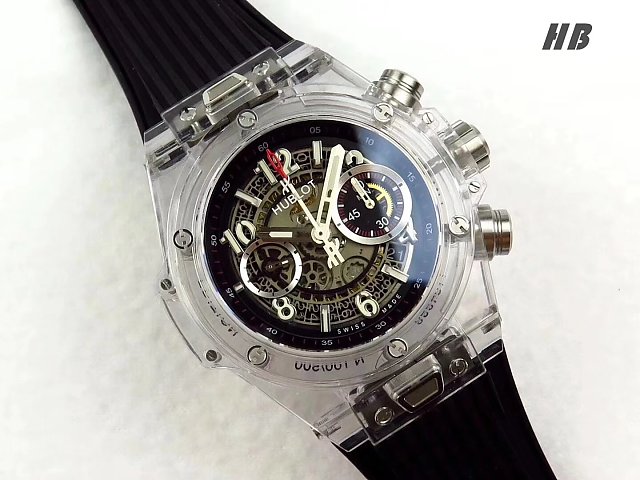
The photographs here belong to an earlier article describing a factory-made version. They are useful for a visual discussion but do not independently establish sapphire composition, movement architecture or water resistance. Material claims should be supported by credible testing rather than inferred from transparency alone.
At the Hublot replica watch journal, the Big Bang is one of several collections examined through design and movement differences. The Unico Sapphire case construction is especially distinctive because visible layers and case hardware are integral to its identity.
Where transparency changes the comparison
Focus on the screw positions, the way the strap joins the case and the uniformity of the clear surfaces. A visible internal ring that sits too high or a cloudy edge can undermine the impression of careful assembly. The finished watch should also remain legible: transparency is less successful when the hands disappear into the exposed structure behind them.

The movement window is another area where descriptions often go too far. A skeletonized view is not proof that a mechanism operates like a named Hublot calibre. The responsible approach is to compare observable bridge positions and display layout, then treat any performance claim as unverified until documentation exists.
Related examples in the Big Bang archive show why sapphire-style transparency should not be judged with the same criteria as a dark ceramic model. The relevant question is whether the case architecture still reads coherently when almost everything is visible.